DISCOVERIES
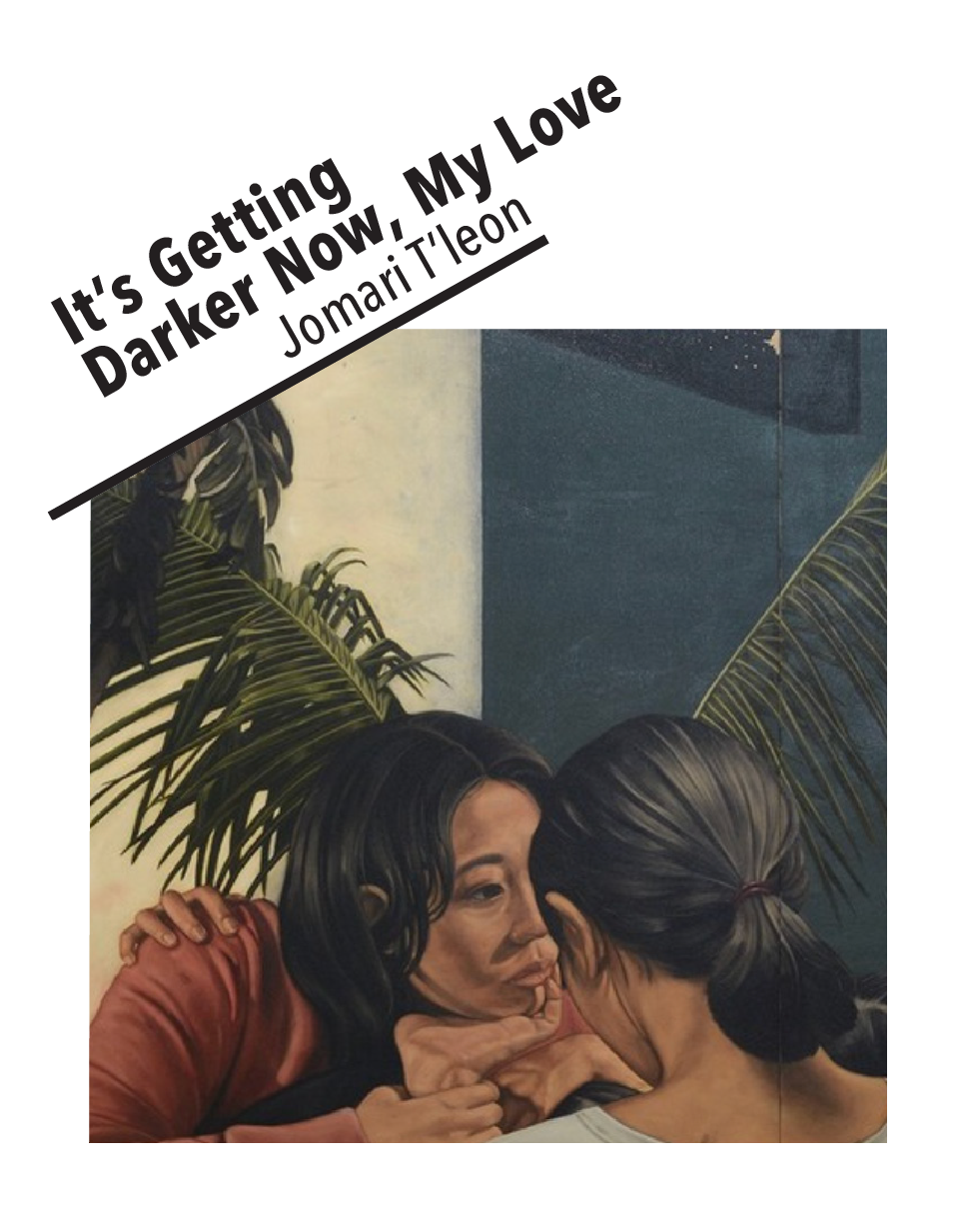
Jomari T'Leon creates his paintings from digitally collaged photos drawn from his personal archive. Seeing T'Leon's paintings, and later recalling them for myself, I find that they are almost narrative. The evocative postures, gestures, and placements of their figures and things make for a charged atmosphere, but one where emotion has been wrenched from its ground. I think they make for three near-stories:
(1) Absolution
On the upper left, a wall-mounted street lamp. In the midground, four figures, their backs to us. One woman in a red, puff-sleeve blouse peeks—but is it really from behind the plaster wall? Not when half of her body is missing from it, not when she doesn't seem to mind her partial disappearance. Nearby, casting her shadow, a woman in a belted blue tunic, its knot-side facing us. Then, at the center, a man rests his arm around a woman’s shoulder, seeking and offering support.
Their postures are weighed with a kind of resignation, the sense of looking at catastrophe helplessly, in full view before you. An accident. Or something burning. Yet they are safe from the fire, it is in fact behind them as a screen, as a patch of collage. And beside it is another woman, with pieces of glassware before her. She is oblivious to the blaze. She is confined to a personal melancholy, a sad complacency which doesn't make sense in this blazing heat. Everywhere, their emotions float, outside their requisite frames of actions, and so everywhere in It’s Getting Darker Now, My Love things only almost-cohere. Our narrative drive and spatial reason tell us that the four figures in the midground are looking at—what? Some torn white fabric stretched across a black steel frame, a three-armed lamppost whose night light serves— whom? That curious burst of bluish light. The arbitrary objects of their gaze do not warrant their grief. At most a fidgety sense of curiosity, or perhaps indifference, seems a more apt response. Their gaze, hidden from us, is directed at what. Collage has made an infinite gap between what they have seen in the world and what they must be feeling, now. Our sadnesses lack their objects. We cannot make them cohere.
(2) After Mass I
Here, too, everything is out of place. A white flower floats in a black patch of space, but lacks the wind that flung it from the branch or the hand that cast it in offering. It is overly large when set against the shadows of seemingly nearer shrubs, against the sousaphone. To their left, the grass and shrubs are interrupted by a clean strip of what. The horns of the marching band gleam gold, but how, by what possibility of afternoon light when all the screens are set in almost-night? The slate blue fabric of the umbrella is still warm to the touch. A hearse proceeds slowly outside the frame.
(n) A brief interlude:
“...intense personal emotions about the shape and fraying of life are also collective...”
– Lauren Berlant
Here, something quickens. Something escapes our cultural grammars. An inconsistent narrative sets crisis to our belief. Resists the usual suppleness of fact. A series of affective changes misplaced; many times interrupted. A change in how we live our bodies. In that instant the physical sensations did not make bodily sense but made for psychological resonance. The cleave of extreme emotion set in unfamiliar resonance. Truer in love, or death, truer in failure, or ambition. We look at a painting and are an intimate public.
(3) After Mass I
Are they drumming to a funereal rhythm in this civil twilight?